Showing posts with label religion. Show all posts

Wednesday, December 30, 2015

More Thoughts on Religion and American Values

I subscribe to the science blog Facebook group I Fucking Love Science (IFLS). It is run by Elise Andrews from LabX Media Group in Canada. Usually posts are about new science breakthroughs in biology, physics, and astronomy. But sometimes there are stories about other science fields like archeology, sociology, and paleontology. These fields sometimes bleed into the humanities.

http://www.iflscience.com/editors-blog/theory-adam-s-penis-bone-creating-eve-causes-outrage
Ina Gadda Davida. Links to the article.

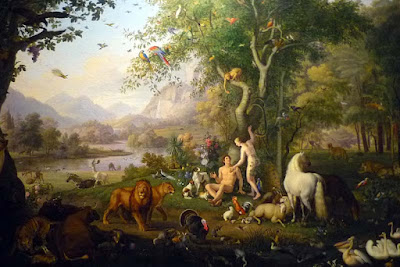
Recently, IFLS posted a story about a new theory published by the Biblical Archeology Society. It is linked to the picture above. The theory combines what we know about basic biological anatomy with studies in ancient linguistics to come up with this idea that perhaps Adam's Rib actually is Adam's Penis. The theory, as I understand it, is pretty clever.  It combines what we know about animal penises and how they differ mostly from our own anatomy, and how ancient peoples must have made the same comparisons, and how they would have used that knowledge to inform their own mythologies. Combine that with how difficult it can be to translate idioms and euphemisms, and the theory does have some traction.

Science is pretty fluid, and allows for new discoveries to amend and change facts and theories based on new evidence. Unfortunately, religion has trouble amending anything, especially if its a common and popularly held belief.

This brings me to the end of the article. One of the detractors of the theory is quoted as saying, "I do not need and will not read articles that damage my faith or attempts to cause me to doubt what I know is the Truth from the Bible".

This statement is very telling, and I think highlights the major issue causing the rift between Science and Religion. Previously on the blog Tom is Clever, I wrote a piece on my own personal thoughts on Religion. In the article I outlined fundamentalism in Christianity. Inerrancy is a major part of fundamentalism, and this quote proves the stubbornness of this idea.

The theory posed above does not detract from or change the biblical theology in any major sense. Eve is still created from Adam, and all the dogma and misogynist code extrapolated from that story can still exist. Having Eve created from a penis bone is, at its core, no different from creating her from a rib, or any other of Adam's bones. So... I find it interesting that even the most hardline Christians would care. If anything, this theory helps explain how the mythology can still exist even with better translations.

The only explanation I can think of, is the need for the very religious to continue to attack and dismiss Science as a whole. It really doesn't matter if it is Science at all. I think anyone offering a differing opinion of what the religion means would be treated the same way by this particular quote. For all I know, this believer's faith, and what he knows to be "Truth from the Bible" could be completely ridiculous conjecture not supported at all by his Bible, or by actual Biblical scholars.

The scary part is, it wouldn't matter. Because this man, and all the other Christians like him have already made up their minds, and out right refuse to acknowledge anything different, no matter if the different ideas, theories, or theologies are far closer to actual Truth.

This attitude doesn't stop with personal theology, however. That is the truly scary part. This attitude of inerrancy and refusal to learn new things has bled into other parts of American society. The Truth in the Bible is not the only thing Americans are unwilling to compromise over. For example, the Second Amendment can not be compromised, not matter how many statistics, factual information, specialists, and experts prove that stronger gun regulations could decrease the number of massacres, and gun related crime.

Refusal to even listen to any other side of any other argument because it threatens personal understandings of the universe is a major problem in all facets of society. This idea that one person already knows the Truth, and anything else must be false creates a barrier where no beneficial discourse could possibly survive. Policies concerning military spending, immigration, tax reform, gun control, and domestic social spending have all been held at a near standstill for decades due to a refusal to back away from popularly held beliefs. Until we can get over the "what I know is right, and what you know is stupid" attitude, there will be no change, and nothing will get better.

Saturday, July 6, 2013

Selfish Freedom of Religion

click me to read the article

This is quite possibly the best article I've read on the Religious Right lobby in America. So much domestic policy seems to be held up by this fear of putting "religious freedom" in jeopardy. However, as this article points out pretty intelligently, religious freedom is really a term used to further an agenda of conservative Christian values.

The focus is on an ongoing lawsuit by the Hobby Lobby, a conservative Christian owned hobby store chain (the Chik-fil-a of the arts and crafts world). Hobby Lobby refuses to offer health care to employees if that health care system offers contraceptives as part of it's plan. The Hobby Lobby wants the same exceptions that religious non-profits receive. The problem is, they aren't a non-profit organization. They are a for-profit corporation. At least this isn't about homosexuality and marriage.


Thursday, June 20, 2013

Surprise! Living a Lie Sucks


So, this is happening today.  The organization Exodus International has closed, and the president of this "Christian" ministry, Alan Chambers, is doing interviews apologizing for his very damaging and unchristian-like ministry which has hurt many people.

Exodus International focused on healing homosexuals, turning them straight through reparative therapy and prayer.  Chambers has gone on record, most famously with Oprah, to denounce this idea of homosexuality as a choice and lifestyle that can be treated through psychological therapy.  Basically, he has realized that brainwashing does more harm than good.  The Huffington Post has an article in more detail.

I'm not sure, but I hope someone else somewhere has drawn parallels between this anti-gay movement and the Inquisition's use of torture to illicit and secure oaths of undying devotion to the Faith.  Frankly, this Evangelical war on homosexuality is disgusting, and I'm glad to see a leader and true believer of this madness flip his position...  how very Saint Paul of him, what a revelation this must have been.

Saturday, March 16, 2013

Defusing the Weapon: Context is Everything

An interesting thing happened this week, and I figured this would be a good place to post and share. Unless you either haven't been paying attention, or just don't care about social politics, you've probably heard about how conservative Republican Rob Portman from Ohio has flipped his views on marriage.

Click me, I link to a New York Times article
Portman has a son who recently came out to his parents. Knowing who his father is, and his stance on certain socially conservative platforms, this act in itself must have been difficult. However, showing his true character, Portman accepted his son, and revised his belief system. It is a little shameful that the issue had to hit so close to home for Portman to shift his platform, but he ought to be commended for revisiting an issue and reforming his opinion based on personal experience, rather than through political soundbytes, and platforms. Another GOP pal of his, Dick Cheney, sent his regards, by the way, which I also thought was interesting, as Cheney has also dealt with the political nature of marriage equality.

I saw this as reported on CNN, and of course, in order to seem fair and balanced, they interviewed Newt Gingrich on what he thought about it, and of course, he did his best to make this whole thing seem unimportant. His reason was basically, no matter what anyone's personal views were about who is allowed to marry whom, marriage will always be a religious definition, and politics wont change it. But, I'm pretty sure politics helped make this whole thing an issue to start with.

This brings me to another thing I wanted to share. I found this doo-dad on the internet today.


The Leviticus chapter and verse is often used as an argument against marriage equality, claiming that, due to this passage in the Old Testament pertaining to one of the 613 commandments of Jewish law, marriage was meant to be between a man and a woman. I won't even go into the theological implications of Christians using old Jewish law to prove dogmatic points, or the fact that there are only certain sects of Judaism that even follow most of these 613 commandments.

What I will do, is clarify this argument better. William's argument, and point is this... if man lies with another man as he does with a woman, then that man is acknowledging that men and women are equals and deserve equal treatment. Since the rest of Leviticus makes several claims that men and women are not equal, and women are subjective to men in a variety of ways, treating another man like he is a woman would not only be disrespectful in the biggest way to the man, but would also undermine all of these other commandments that establish this patriarchal system.

Things that the religious right and hard line conservative Christians say to back up policies of anti-gay sentiment often lead me to think about a pretty famous Canadian evangelical preacher. Charles Templeton left the ministry in 1957 after 20 years as a devoted and moving evangelical preacher. Templeton had been studying scripture at Princeton at the time, and denounced the faith abruptly.


Many many years later, Lee Strobel interviewed Templeton, and although Templeton had been a self imposed recluse and a staunch atheist, when asked about Jesus Christ, Templeton had this to say:

"He is the most important thing in my life... I adore him.  Everything good I know, everything decent I know, everything pure I know, I learned from Jesus".

There is more about that interview here. What I take from this, is not an example of Christianity "winning" one against atheists, but rather, an example of how the religion has moved so far from it's original intent, purpose, mission. Clearly, Templeton did not privately denounce his spirituality, but rather turned away from this religious propaganda machine that he helped make strong. Mr. Portman, like Templeton, discovered that sometimes those things we learn from Jesus: compassion, love, ethics, are far more important than politics, social agendas, and phobias. Jesus had, in effect, undermined the old Judaic system, which is something that the conservative right have been clinging to, regardless, ever since.

The best part of William's post is the last line when he states, "the bible is used as a weapon". The best way to stop this is to be educated about what the text is actually saying, and to whom it is actually speaking. What would Jesus do, indeed? God, and the people at the time had specific reasons for commandments, and it is irresponsible to not take those factors into account when attempting to use certain passages as a basis for oppression.

Saturday, February 23, 2013

Where Literature and Video Games Meet

I usually don't write about video games. I'm pretty sure I said these same words the first time I wrote about music or movies on this blog too. Most games I play don't really deserve mention anywhere outside of maybe a comment about how I played it, and it was alright, or good enough to buy, or whatever. Sometimes though, sometimes there is a game that defies expectations, or flies under the radar, or is so abused by critics that it is never given a chance to be appreciated for what it truly is.

The other day, bored with my other games, I decided to play Dante's Inferno again, from the beginning, with a clean slate. For a little background... this game came out in 2010 from EA and Visceral Games. It was almost universally panned for being a rip off of popular Play Station franchise God of War. Also, there was much criticism about the decline in intensity the farther one played into the game. The most interesting parts of the game being closer to the beginning, and the more monotonous levels were closer to the finale.

This is just Limbo.  It's like level one.  
As I give this game another shot, I find myself appreciating the visual style of the game. Based on the first part of the literary masterpiece the Divine Comedy, this game follows the voyage into hell taken by Dante and Virgil. Of course, it is a video game, and there are plenty of deviations from the actual text with regards to plot, but the basic ideas, themes, and world building are essentially right out of the text.

The game is designed beautifully around the text. Each level has it's own distinct themes and visuals, with the overall theme being hell. The developers did such a good job designing hell, that I've seen screen shots used by the History Channel in documentaries about religion and cults.

City of Dis
The in-game storyline, and subsequent levels of the game take much from the text. The main character is Dante, reimagined as a crusader. Dante travels through Hell to save his love Beatrice (based on the actual Beatrice Portinari, the subject of another Dante work, La Vita Nuova) from the evil clutches of the devil.

Throughout the game, and in the proper circles in which they appear, you meet Virgil, Charon, King Minos, Cleopatra and Antony, Cerberus, Ciacco, Plutus, Filippo Argente, Phlegyas, among others. There are a few characters that don't appear, like Nessus the Centaur, and the Minotaur that guards the gates to the 7th circle. This was a little disappointing, but I do understand that not everything in a literary masterpiece can appear in a video game. Because I know a little about the actual work, this game became more interesting to me as I discovered how close the writers used the actual text to inform the storyline, characters, mythologies.

Speaking of characters, Beatrice, who is the most important character, in fact, the driving force behind the entire plot, doesn't actually appear in the Divine Comedy until Dante reaches Paradise (which is the third part of the trilogy, the Inferno is the first). The character of Beatrice in the game has been criticized as being too helpless, child-like, and naive. Apparently, we are too forward thinking to appreciate a simple damzel in distress storyline. However, as the game progresses, there is a realization that instead of Dante saving Beatrice from Satan, it is actually Beatrice who saves Dante from any of the circles of Hell where he deserves to remain. And although she does succumb to Lucifer, falling deeper into her new role as the queen of Hell, ultimately she is the one to break Lucifer's hold on her, not Dante.
Beatrice goes through some... changes
So, is this just a carbon copy of God of War? Not really. For one thing, it is a multi-platform title, meaning I didn't have to own a specific type of machine to play it. Only Play Station owners can enjoy God of War. There is more to the game with regards to collecting things to boost your abilities that isn't present in God of War and a Punish/Absolve aspect that relates to the damnation/salvation theme. Also, I have found myself playing the game repeatedly, without having to rely on online play. That can't be said of other franchise titles like Call of Duty, or Gears of War. Also, I didn't reach the end and realize it ended too quickly and I was expecting more, like Assassin's Creed, Batman, or Dishonored.

Probably rated M, by the way
I recommend for anyone who enjoys action games with some puzzle elements, fans of demonology, the occult, classic literature will enjoy the themes, visuals, and story elements.

The end of the game leaves itself open to sequels, which would make sense, as the Divine Comedy is a three part journey. It would be difficult making Purgatorio and Paradiso into an action filled fighting/puzzle game like Inferno, but seeing as how Visceral is not above tweaking and outright changing key plot points to make the game interesting and challenging I still see the other two parts as doable. However, Visceral has stated repeatedly that they will not be pursuing the other two parts of the Divine Comedy much to my dismay. I would have liked to see how they designed those realms and what story they would tell in order to make Dante need to slay more creatures.

Saturday, January 5, 2013

Denial 101: Hopelessly Clinging to... Something

This is another post in the series of trying to understand stupid people.

I found this today: a paper proving that dinosaurs were not real, and it's just a huge hoax.  This, of course, is full of logical fallacies and is based nearly entirely on the premise that the religious text of Genesis is undeniable fact.  Further proof is the picture below.  One can only hope murieljcompton is an instigator commonly known as a troll.  But this is probably, and sadly, legit.


The overwhelming belief in Creationism is of course responsible for this fringe conspiracy theory actually gaining considerable support in the face of rational thought. Creationism, and the inability to understand how petrification and fossilization works, has led to an irrational dismissal of science. It is also interesting to note that according to this board, even the crazy conspiracy theorists think Creationism is nuts.

I can understand how indoctrinated hate works, I can understand Pro-life.  I can even understand the fear, misunderstanding, and misinformation that leads to racism, homophobia, and the oppression of women.  What I can't understand is Creationism.


These statistics give a pretty clear picture on Creationism in American. And no huge surprise, there is a correlation between education and belief in Creationism. I am actually impressed that there are people out there living and participating in a society that is arguably the strongest post industrial nation on the planet, who still cling to the theology of the Middle Ages. These people vote in national elections, and yet have made the choice to dismiss much of the science that allows modern humanity to understand our world and universe. Creationism's essential belief, that the world is only between 5 and 10 thousand years old, was rejected by theologians as early as Philo (50 CE) and Augustine (430 CE), and by the majority of serious scholars by the 18th century.

How can you go through 12 years of grammar school and, at the end of it all, deny everything you learned in science classes as not legit? You'd have to be either incredibly stubborn, incredibly stupid, or when confronted with the seemingly incompatible ideas of science and religion, instead of trying to reconcile the differences and find meaningful ways for them to coexist (like the Catholic and Anglican churches have) you just threw up your hands and ran screaming from the room.

I guess it all comes down to some people unable to think for themselves. They must have been absent the day the schools taught how to make an informed opinion. These are the same sorts of people that try and ban books, change textbooks in school, handle poisonous snakes and believe god will keep them from being bitten, do these sorts of things, and ban dancing until Kevin Bacon saves the day.

Thursday, August 25, 2011

an update

I found this today:


It reminded me of the post I wrote not too long ago about Christianity in America and my crisis in faith.
This speaks to the double standard of the religious right.  Basically, it strengthens the belief that religion and politics shouldn't mix.  ever.  Also, I do think it's a little funny that "true believers" find the faith to be self serving, and by a little funny, I mean awful.

Sunday, July 31, 2011

Thoughts on Christianity

Recently, I have found that a central part of my life up until now has come into personal doubt, probably more than any other time in my life.  I had grown up identifying as a Christian, mostly because my father is a pastor and church-life and community have been central parts of my life, more than most.

On top of this unique upbringing, I also was privileged to grow up in diverse, upper middle-class neighborhoods with good schools. I think I have always struggled with some of the fundamental beliefs that are associated with Christianity, and also with perceived hypocrisy of many of the belief systems and cross culture.

A glaring example of this was the countless number of Christian denominations. As a kid I couldn't understand the necessity for so many different churches. They all claimed to be Christian places of worship, after all, however not all "Christians" are welcome in all "churches".


The other day, I realized that I do not readily share the fact that I am Christian, even when in company of other people who do identify readily as such. I had been hiding for quite some time and I realized it was for a few reasons.
  • As learned in high school debate, religion is seldom a good topic to bring up in conversation, someone is going to get angry
  • I am not always good at articulating my personal belief system without sounding crass.  
  • lately, the term Christian has become synonymous with the American religious right, pro-life, the Bible Belt, the subjugation of women, and Creationists; all of which I would rather not be confused with
I do realize that hiding as a Christian, or at the very least some sort of intellectual Christian hybrid, is antithetical to being a Christian. As is stated in the gospels, specifically in Matthew 4:13-16, one shouldn't hide their light, but put it on a stand for all to see. Or, if that is too difficult to understand, -- stop hiding who you are. This is considerably more difficult recently due to what I'd like to call a hijacking of the religion by politically motivated zealots, and intellectually stunted fundamentalists.

I looked up fundamentalism earlier. Usually I only trust the Oxford English Dictionary to give me the best unaltered definition for a term. Most other commercial dictionaries (mirriam/webster) like to change things to be trendy... this is a subject for another post. The OED gives the definition of fundamentalism as follows:
  1. a strict adherence to ancient or fundamental doctrines, with no concessions to modern developments in thought or customs. 

  2. (specifically for Christianity) A religious movement,
    active among Protestant bodies in the United States after the war of 1914-1918, based on strict adherence to certain tenets (e.g. the literal inerrancy of scripture) held to be fundamental to the Christian faith.  
Just to be clear, inerrancy means it is never in error, and is assumed to be truth. The biggest issue with fundamentalism I have is the inability for flexibility. Peter J Gomes, the late Harvard professor/theologian stated:

"One of the many things one can say about this country is that we dislike complexity, so we make simple solutions to everything that we possibly can, even when the complex answer is obviously the correct answer or the more intriguing answer. We want a simple yes or no or flat out this or absolute that. And the notion that God can have two thoughts simultaneously, and that people didn't or don't think and talk like us is hard for us to believe."

Gomes was talking specifically about American Christians, and I think this holds true for the most part. However, to be fair, this has more to do with fundamentalists in general.

I found this on the interwebs today. It basically outlines Christian Fundamentalists mainline belief system very neatly, and highlights the problems involved with this kind of thought. I can sum it up here pretty quick, although, I urge people to read it themselves.
  1. Inerrancy is based on the King James Bible of 1611, and that is the only true text
  2. the idea of belief in faith alone as preached by Augustine, and borrowed by Luther and Calvin, see all humans as depraved, born of sin, and also creates an idea of elitism.  Special chosen people are placed above normal mainline believers, much like Nietzche and Hegel's Superman theory.  
  3. there is a conscience effort to react back to a time when Christianity was simple and basic.  Puritan American has become the ideal, even though it is somewhat of a myth.  
  4. Democracy and Equality can not coexist in a Christian environment.  
  5. the reaction to modernism has opened Fundamentalism up to occultist, racist, hate-filled and paranoid beliefs and practices.  
There are several things I have issue with concerning these doctrines. The biggest one is that after reading it all, it does seem like rules were made specifically to keep anyone from having to face newly discovered facts and have to restructure their belief system. No one has to be reactionary if you don't believe in progress to start with. Let's go over these points, starting with...

#1. First of all the King James Bible was published in 1611.  That's 1578 years (nearly) since the death of Jesus.  Pretty sure we can find an earlier more reliable text, preferably one translated unbiased from Aramaic and Greek.  It was also translated by 6 groups of 10 people...  Christians are pretty trusting of nearly 60 Anglicans to not mess up the Word of God.  I suppose Christians ought to find one universal text to use, but why pick the one known to have the most errors?

#2. This pessimistic, self loathing idea of humanity leaves a sense of hopelessness to life in general.  Hope is a central theme in Christianity.  Not only does this destroy hope, but it also points fingers.  Also, the idea of Faith Alone allows people to ignore common sense, like snake handlers, and faith healers.  No matter how much one prays, broken bones and snake bites wont heal themselves.

On top of that, elevating some people to positions of impunity could lead to those positions taking advantage of others...  much like Catholic Priests take advantage of children.  That's right, I went there.

#3. Puritans were not really Americans anyway.  by 1776 the Puritan Ideal was mostly extinct.  Opposition to oppression of non-Puritans, the Salem witch trials, and Unitarianism led to a Puritan decline in the 1690s. The United States was founded in 1776... 80 years in the future, most of these Puritans would be dead.

#4. The United States is a democracy of sorts, and equality does pretty well here for the most part. There are a few Christian denominations that govern themselves democratically. This basically means statement 4 is false.
#5. The Ku Klux Klan, Neo-Nazis, the Orange Volunteers, the MNCA, the Iron Guard, Army of God, Lambs of Christ, Westboro Baptist, and several Christian militia groups (think Timothy McVeigh) are all examples of groups that identify with Christian beliefs, just to give a few examples or extremist groups that promote occult, hateful, paranoid delusion.

One might question how groups like this can exist and call themselves Christian. As the very nature of hate seems impossible to exist in the same teachings as Christ. This is a valid question. But, remember, fundamentalists promote elitism. Most Christians, instead of talk about this issue, push it aside and refuse to acknowledge these groups as Christian, or that they even truly exist at all, or even worse, secretly sympathize. No matter how much one denies them, these groups still think of themselves as Christian and self identify that way, doing the things they do in the name of God and Christ.

For me, being a Christian means a few basic things that ought to be foremost in the thinking and ideology of all Christians. These are things that I find essential:
  • Golden Rule. I shouldn't have to explain this, since it is pretty universal. According to the Mahabharata 5, 1517 it is expressed as "do not unto others as you would not have them do unto you". In the Udana Varga it appears as "hurt not others in ways you yourself would find hurtful". The Talmud puts it best I believe when it states "What is hateful to you do not do unto your fellow man. This is the entire Law, the rest is just commentary" (Talmud, Shabat, 3id). This, as good Christians ought to know is the basis for Jesus's teaching of the Golden Rule in Matthew 7:1. Not only that, but it has its own parable as expressed by the Good Samaritan, which basically explains that no matter who the person is, they should be respected as a human being. This rule also pops up in Islam, Confucianism, the Tao, and even Zoroastrianism. Knowing this really gives no one an excuse to use any religion as a tool to do evil.  
  • Jesus Christ is the spiritual guide for the entire religion. He is the reason for the faith. Therefore I would think whatever Jesus is credited with saying in the gospels would be the ultimate fundamental building blocks. Not Paul and his letters, not Augustine, not Luther, just Jesus. Pretty sure this would clear up some theology that seems to be based on hate and oppression. What would Jesus do indeed?  
  • We know, from reading both the Old and New testaments, that Jesus (see above bullet) took old scripture and adapted it for his time and place and people. Therefore (I am going out on a limb here) Christianity must have been meant to be able to change. And since Jesus stated the two most important commandments of all are to A: love god above all else, and B: Golden Rule (see first bullet) one can assume that anything else that subjugates, oppresses, bullies, or murders human beings especially in the name of Christ would be antithetical.
This brings me to the real reason I'm writing about religion on my otherwise spiritual-less blog. Christian-Americans. It is impossible to watch, or read the news without running into religiously motivated political rhetoric. I would like to clear things up, perhaps someone ought to comment to set me straight with good supporting evidence if I am wrong. I am pretty sure this country is a secular nation.

The Constitution in this country was in fact written by a bunch of dudes who lived their lives by Christian values, I suppose. But those values in 1776 did not match Puritan ethics from 1620. Most of the founding fathers one may want to name drop were truly Deists. A deist, according to the OED, is someone who believes that reason and observation of nature can prove that the universe has a creator and that this creator does not intervene in human affairs or change the natural laws of the universe. Benjamin Franklin, Thomas Jefferson, Cornelius Harnett, Gouverneur Morris, Hugh Williamson, Thomas Paine, and possibly Alexander Hamilton and Ethan Allen were all Deist thinkers.
On top of that, the first Amendment to the Constitution, made law on December 15, 1791, makes it very clear in the Establishment Clause that Federal, State, or Municipal (means local government), establishment of a preferred religion is prohibited. This was originally written specifically for laws enacted by Congress, but Giltow vs New York in 1925 ruled that it (and the rest of the First Amendment) applies to all states as well.

Some would argue that this doesn't state separation of Church and State and that the Founding Fathers still meant to have a place for God in matters of state. However, Thomas Jefferson (writer of the Declaration, signer of the Constitution, Third president) confided in a letter to the Danbury Baptist Association (Connecticut) that separation of church and state is important for the safety of liberties both public and private. This would lead one to believe that the founding fathers did indeed intend for church and state to remain separate. On top of all of that, churches are exempt from taxes. It is my belief that if one doesn't contribute to the government, one should have no part of the governing affairs.

I have no problem with individuals using their faith to make good decisions, however. Moral and ethical codes are often linked to religious teachings (see golden rule stuff above). Even having officials in office use religious background to make policy, interpret rulings, and govern their actions is definitely acceptable to me.

However, religion is not the beginning and ending of decision making. Everyone should make informed opinions based on multiple sources for fact and truth, not just personal interpretations of the Bible alone. The idea of inerrant biblical truth as a tool to govern is silly and dangerous, especially in a nation where all of the constituents represented are not Christian from the same theological school. This is sloppy, irresponsible, and immature representation and should not be tolerated by any patriotic American.

An example of leading a nation using only inerrant biblical theology would be people who call themselves Christian referring to the Torah (first part of the Tenakh, first five books of the Old Testament) as a basis for arguments supporting anti-homosexual rhetoric. The idea behind this, is that combining ancient Jewish law with selections from Paul's letters (not Jesus's teachings) proves God condemns homosexuality, and therefore United States law should follow suit. I already established the need for separation of church and state earlier, but one cannot control another's bias. Also, the Torah is Jewish Law...  not necessarily Christian.  Plus, it leaves no flexibility for modernity. The Torah also bans pork, ham, bacon, pigskin, shellfish, blended fabrics, working on the Sabbath (Saturday or Sunday, take your pick), as well as a host of other rules concerning farming, marriage, food, etc.  Enacting law based purely on the Torah in America would not only drastically change the economy, but also change sports, and notions of family. Also public stoning for a variety of misdemeanors would be entirely acceptable. If you truly want to go by Talmudic Law, then become a Hasidic Jew. If you just want to pick which rules to follow, like some sort of religious buffet, then be open about it. Take pride in the fact that you are searching for biblical reasons to support your hate. Otherwise, let this one go.

In short, in this country, there is no us and them. Everyone is an American regardless of religion. The laws that govern the country, and the building blocks of the Constitution and Bill of Rights, are for everyone, not just Christians. Christians should be the first in line to defend and protect the rights of all Americans to free speech, free assemblage, and free worship. I am sick of hateful comments directed at other minority religions in this country by "Christians" which are based and fed by fear and misunderstanding.

Lastly, and possibly the thing that angers me the most is this desire to "save" people. Fundamentalist Christians have this arrogant view that if another person doesn't confess their undying devotion to Christ they must be sinners by default and have to "come to Christ". A good Christian is one who can share his faith with others. Remember the scripture from Matthew, don't hide yourself. This of course leads eager Christians to proselytize to others, proclaiming Christ, elevating stories of people who have turned their life around, and shaming the ones that are more reluctant. Sounds a little misguided.

I do not mind the sharing of belief systems with others. Do not misconstrue. Methods used, such as inviting neighbors and friends to come with you to church, doing mission work in the name of Christ, etc, are all fantastic. The agendas behind some missions, though, bother me, especially when homosexuality is involved.

This is a touchy subject for Christians. There are passages from scripture that may be interpreted as expressing homosexuality as a sin. These are often lifted up by fundamentalists to denounce homosexuals and justify hateful protests, condemnation, and omittance. Most of the time when I broach this subject with Christian conservatives, they first of course deny that they hate anyone, but affirm that they believe homosexuality is a sin. They also deny that homosexuals are not encouraged to come to church, a practice pretty well documented. However, although they welcome homosexuals to come to church with them, the true reason behind it is the hope that the homosexual guest will begin to renounce "the lifestyle" and be "saved" (read no longer gay). It is this hidden agenda that angers and disappoints me the most.

I hope this "welcome under one condition" policy, and misguided, backhanded Christian sentiment changes. According to Tony Campolo, professor at Eastern University at St David's, this has already begun. "Jesus", he states, "never mentioned homosexuality. It just wasn't on his Top Ten list of sins. Number one on that list, however, are judgmental religious people who look for sins in the lives of others without dealing with the sin in their own lives".

Campolo goes on to talk about Lewis Smedes, a professor at Fuller Seminary. Smedes decided that although he did not believe that homosexuality was something that God has originally intended, it was something that does exist now, and as such, it is something we must handle. Lifelong committed relationships, Smede said, between homosexuals are indeed the "circumstantial will of God" and should be honored and protected by the Church. This is a HUGE step for Christians, as both of these men were upstanding evangelical preachers with much influence with the religious right in this country.

One can only hope things move along in a direction that can eventually see all people treated as human beings.
Monday, July 13, 2009

Subconscious Animism

I found this interesting, while rereading selections from my copy of the Ecocriticism Reader (why would I want to refamiliarize myself with that,I wonder), I came across the theory that western culture has purposefully eliminated an otherwise inborn connection with nature.
Dr. Christopher Manes, PhD in Medieval Studies from the University of Oregon, and author of Green Rage, poses the idea in Nature and Silence that up until the prominence of Judeo/Christian thought, Nature had a personality, a voice, and only through this silencing of Nature, has Man solidified sole status as the only speaking subject.

Lynn White, Jr, former director of Medieval and Renaissance studies at UCLA, and professor at UCLA, Mills College, Princeton, and Standford, points out that due to a fundamental pillar of Christian dogma, western culture thinks of itself as apart from nature. "To a Christian, a tree can be no more than a physical fact" (White). The point being that the Judeo/Christian idea that Nature exists to serve Man has allowed for the truth of Man's "transcendence of and rightful mastery over" Nature. Therefore, the use of natural resources and by extension the exploitation of the planet for profit is validated. According to Kant, reason is related to political power and self interest. Why not use the land? The highest religious power says its ok, and we can make money while doing it.

However, if human beings and nature are truly disconnected, one apart from the other, how have "primitive" cultures of the past and present have been able to thrive within a communal relationship with nature? The answer, Mane says, lies in relations. There has existed in EuroAmerican culture this idea of "privileged speakers", which up until recently has meant "rich white dudes". Our culture had done its best to silence the voices of people of color, women, and children, thus making it easier to exploit these various groups, to the point where drastic counter movements were staged to reaffirm and empower the voiceless. The point being, if Nature is allowed to have a voice and be personified, it is more difficult for it to be exploited.

Here is the cool part: even though in our culture, it is considered crazy, tribal, and uncivilized, "in modern technological society animistic reflexes linger". Exhibit A: Cars and sports teams. As a culture we have attempted to cast the power of certain animals by naming things after them. Exhibit B: Children are not considered mentally insane when talking to stuffed animals, dolls or other toys, and people often lose their temper and shout and curse at inanimate objects, like that broken washing machine, or the Ford Mustang that just stalled on the freeway onramp. The idea is that people in these situations have created a "animistic subject, a shifting autonomous articulate identity that cuts across human and nonhuman identity" (Manes). Pretty cool, eh? I thought so.
The overall point? Final summation? Perhaps we should suck it up and stop pretending we are apart from the natural world. People talk to their house plants, dont they? The fact that there is overwhelming evidence that preservation and conservation of natural resources not only makes wise business sense, but also keeps everyone living here healthier, should be enough incentive to once again become a part of Nature.